
Printing system
How Beverage Can Printing Works
Beverage-can printing is a specialised industrial process with its own colour, separation and artwork constraints.
An indirect printing process
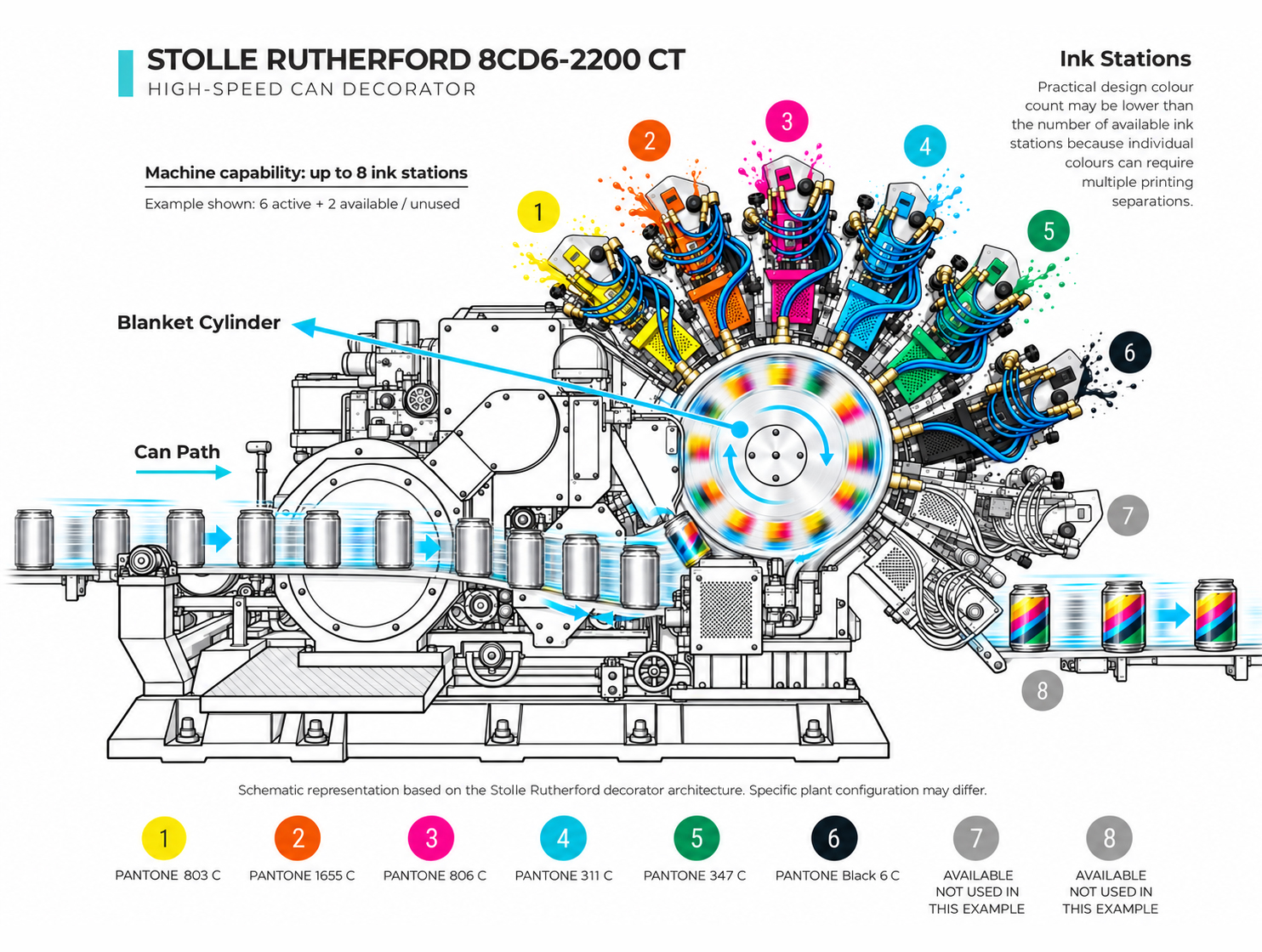
Conventional two-piece beverage cans are commonly decorated using a dry-offset process. Raised printing areas on individual plates transfer ink to a common printing blanket. Individual colours are transferred to the blanket in sequence and are then transferred together from the blanket onto the can.
The artwork therefore has to be designed for the actual printing process, not treated as ordinary commercial printing applied to metal.
Spot colours are the normal production logic
Conventional can printing normally uses dedicated premixed spot inks. Each required production colour is formulated to match a defined colour target and normally occupies its own printing separation.
A colour reference functions as a production target, not as a CMYK recipe.
A controlled solid orange, for example, should not be assumed to result from simply overprinting solid red and yellow. Where a defined solid orange is required, it would normally be treated as its own production colour.
Visible colours do not automatically equal printing plates
A single visible colour can require more than one plate when different parts of the artwork require different printing conditions, such as solid coverage, fine detail, halftone screening or different density requirements.
4 design colours do not necessarily mean 4 printing plates.
Final separation and plate count must be confirmed for the intended production environment.