
Printing system
Digital vs Conventional Beverage Can Printing
Two production routes with different artwork, colour and approval requirements.
Introduction
Beverage can decoration can follow different production routes depending on quantity, market objective, artwork complexity and the available production setup. Digital Direct-to-Can and Conventional Dry Offset address different production needs.
Neither route is inherently better. Each solves a different production problem. They are not simply the same process at different quantities: artwork preparation, colour systems, production setup, quantity economics, finish behaviour, proofing, approval and production constraints differ.
Digital Direct-to-Can
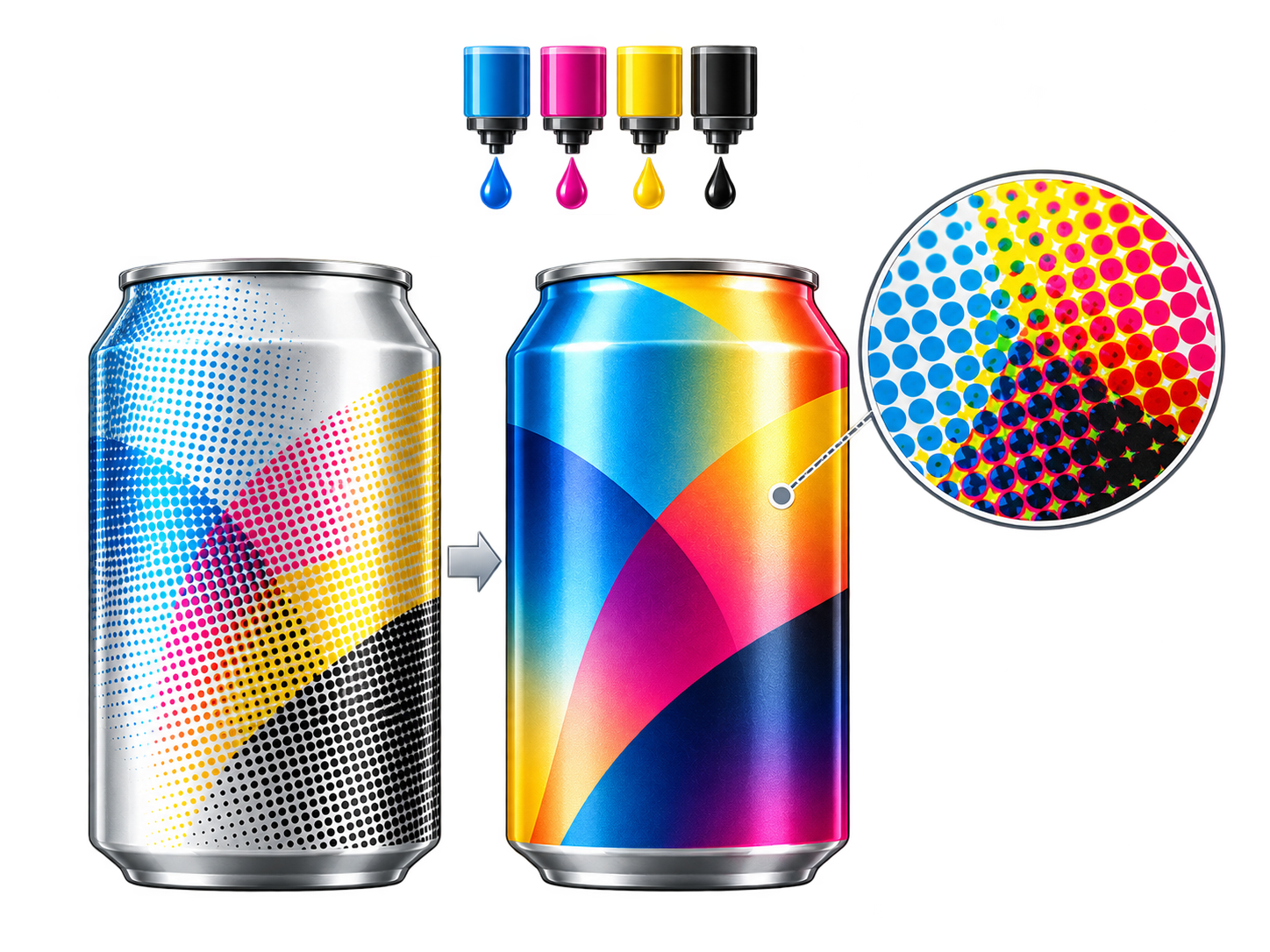
Digital direct-to-can printing is suited to short runs, market validation, pilot launches, limited editions, promotional production and regional or temporary SKUs. It can support photographic and multi-colour artwork without traditional printing plates.
The exact colour model, white layer, metallic treatment, coating and finish possibilities depend on the selected production provider and equipment. Artwork must be prepared for that system rather than assumed to work identically across digital facilities.
Minimum quantities and commercial thresholds are provider-specific. The economics of a pilot or limited run need to be assessed against its purpose, format, setup and delivery requirements.
Conventional Dry Offset
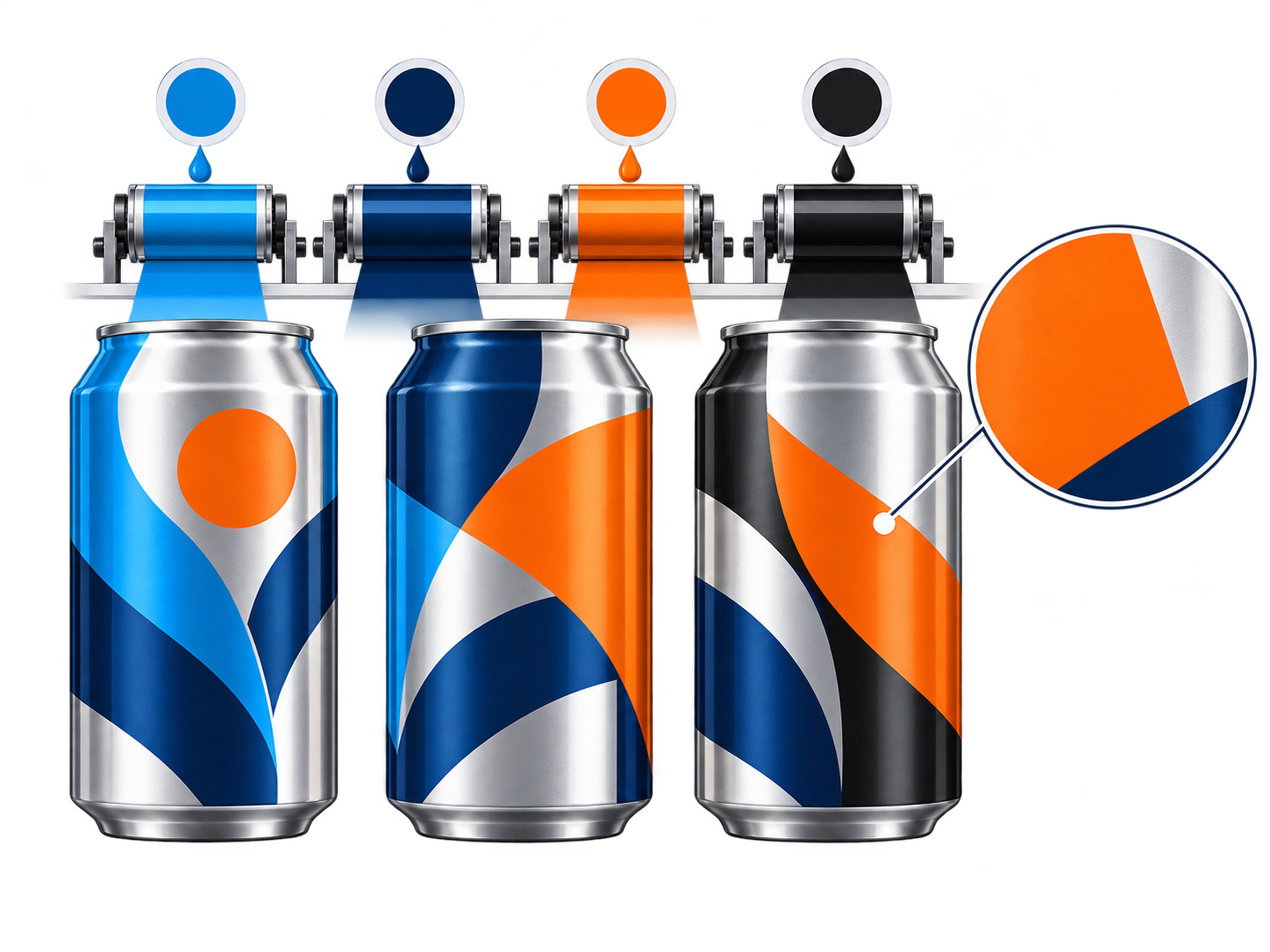
Conventional beverage can decoration is designed for industrial-scale production. Dedicated printing plates carry artwork separations, typically using premixed spot inks. Individual colours transfer sequentially to a common blanket and then transfer together from the blanket to the can.
Artwork separation, ink opacity and transparent ink behaviour must be considered together with the substrate. Exposed metal, basecoat and the selected inks influence the physical colour result. Finish requirements and approval references are production-specific.
Commercial minimums and technical capabilities vary by manufacturer, production facility and can format. Neither a fixed colour count nor a single minimum quantity should be assumed for all manufacturers.
Key Differences
| Production aspect | Digital Direct-to-Can | Conventional Dry Offset |
|---|---|---|
| Typical use | Pilots, validation, limited editions and promotional runs. | Established products and industrial-scale supply. |
| Production scale | Short-run flexibility; thresholds depend on the provider. | Industrial-scale production; minimums depend on facility and format. |
| Printing plates | No traditional printing plates. | Dedicated plates for production separations. |
| Colour approach | Equipment-specific digital colour model and colour management. | Typically premixed spot inks with defined separations. |
| Photographic artwork | Can support photographic and multi-colour artwork within equipment limits. | Requires production-specific separations and halftone planning. |
| Metallic interaction | Depends on the white layer, inks and equipment capabilities. | Depends on ink opacity, exposed metal and basecoat. |
| Artwork preparation | Provider-specific files, templates, colour and white-layer preparation. | Spot separations, plate planning, trapping and facility-specific limits. |
| Finish options | Coatings and finishes depend on provider and equipment. | Varnish and finish options depend on the production facility and line. |
| Iteration speed | File changes do not require traditional plate remaking; schedules remain provider-specific. | Changes may require new separations, plates and renewed approval. |
| Production approval | Provider-specific proofing and physical print approval. | Manufacturer-specific prepress, colour references and production approval. |
| Best suited for | Testing a market or producing a defined short-run requirement. | Supplying repeatable industrial volumes with an approved production specification. |
Digital Does Not Automatically Scale to Conventional
Artwork validated through digital direct-to-can printing cannot automatically be transferred unchanged into conventional dry offset production. A digital result demonstrates what that digital system can reproduce, not what a different industrial printing system can produce reliably.
Production artwork may need to be re-engineered for spot-colour separation, ink count, opacity, trapping, minimum line and gap requirements, halftones, metallic substrate interaction, basecoat, finish and production-specific templates.
A screen preview is not a physical approval reference for either route. Colour requirements must be translated into the selected production system and verified under its intended conditions.
A successful digital pilot is a market validation result, not automatically a conventional production specification.
From Pilot Run to Industrial Scale
A general transition starts with the concept, uses a digital pilot to validate the market and turns the learning into adapted production artwork. Manufacturer feasibility review then establishes whether that artwork can move into conventional production and scale.
The transition must preserve the validated visual identity while adapting the artwork to the selected industrial production system. Confirmed inputs, controlled artwork versions and renewed approvals keep market learning connected to production decisions.
- 01
Concept
- 02
Digital pilot
- 03
Market validation
- 04
Learn
- 05
Production artwork adaptation
- 06
Manufacturer feasibility review
- 07
Conventional production
- 08
Scale
Choosing a Production Route
Consider the required quantity, purpose of the run, launch or validation stage, artwork complexity, colour requirements, metallic effects, available formats, production facility, timeline and expected future scale.
A route that serves a temporary SKU may not be the route intended for long-term industrial supply. Where future scale is expected, plan the artwork transition and manufacturer review rather than treating the pilot files as a finished industrial specification.
Route selection should happen early because it affects how the artwork is prepared and which production decisions and approvals are required.
Closing Principle
The production route is not only a quantity decision. It defines how the artwork must be built, interpreted and approved.